News/Blogs
Your Clients May Be Paying for Savings They Never Receive
Rising pharmacy costs are the hardest conversation you have with clients right now. The 2027 forecasts say it gets harder.
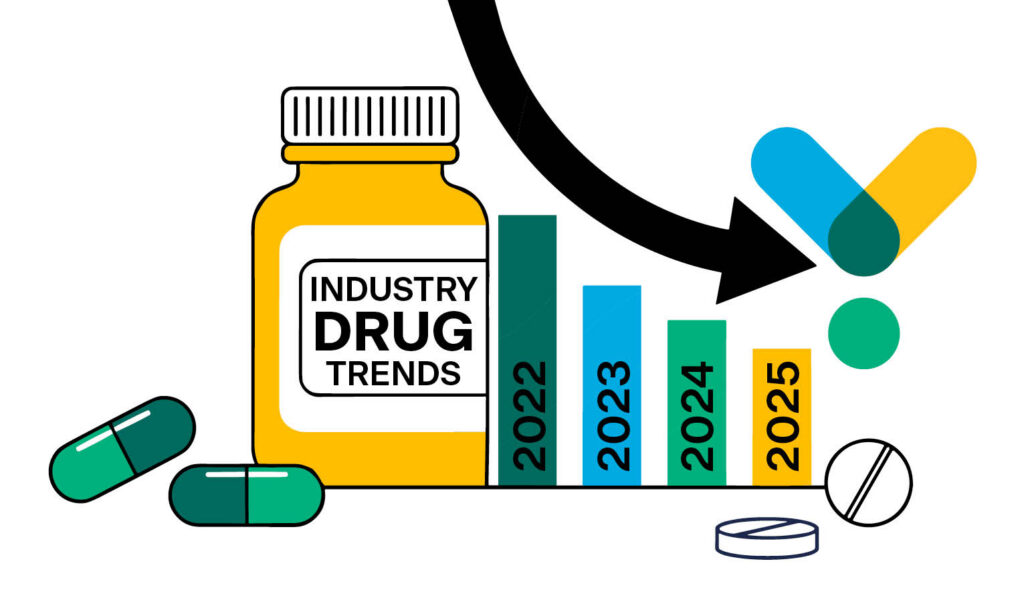
More than 85% of the health plan actuaries PwC surveyed for its 2027 medical cost trend report expect pharmacy trend to outpace overall medical trend next year.¹ Not match it. Outpace it.
The overall number is not gentle either. Those same actuaries project a 9% group medical cost trend for 2027 and 8.5% in the individual market — and PwC restated its 2026 estimates upward, from 8.5% to 9.0% for group and from 7.5% to 8.5% for individual.¹ Medical cost trend is the projected year-over-year increase in the cost of treating patients, holding benefits constant. It is what insurers use to set premiums.¹
Here is the harder finding, and the one worth bringing to your clients. PwC’s analysts write that the historical cost-trend deflators — biosimilars, generic drugs, and site-of-care optimization — still play a role, but health plans have already built them into baseline assumptions. They are no longer enough to materially bend rising trend.¹
Which raises an obvious question. Biosimilars are supposed to lower costs. Where are the savings going?
The savings exist. Someone else is keeping them.
PwC’s own pharmacy guidance is that managing trend will take more than traditional formulary controls, and their recommendation to plans includes accelerated biosimilar conversion for meaningful savings — while naming uncertainty around PBM transformation, transparency, and pricing reform as a complicating factor.¹
Consider why conversion doesn’t reliably produce savings. Each of the Big 3 PBMs now owns a private-label distributor that markets biosimilars under its own label. For 2026, each has excluded most marketed biosimilars from its formulary in favor of the one its own subsidiary distributes.²
| Big 3 PBM | Affiliated private-label distributor | Based in | What it markets |
| CVS Caremark | Cordavis | Ireland | Humira, Stelara, denosumab biosimilars |
| Optum Rx | Nuvaila | Ireland | Humira biosimilars |
| Express Scripts | Quallent Pharmaceuticals | Cayman Islands | 58 products — including Humira and Stelara biosimilars plus 55 generic drugs already widely available from other manufacturers |
Biosimilar competition is genuine. So are the price reductions. But when the entity providing the formulary also distributes the product, the discount has somewhere else to go before it reaches the plan.
Biosimilar access is not the differentiator. Whose biosimilar, at what net cost, still is.
And when a biosimilar does arrive, the manufacturer has an answer for that, too.
Adalimumab biosimilars reached the market in January 2023. By their one-year anniversary they held roughly 2% market share, largely because PBM and payer policies favored the reference product.³ That share climbed to about 22% by October 2024, mostly after Caremark moved Humira off its formulary in favor of a biosimilar.³
By then it no longer mattered as much. In the third quarter of 2024, Skyrizi passed Humira as AbbVie’s top-selling product.³ Skyrizi treats several of the same conditions. It has no biosimilar. AbbVie holds exclusivity, and biosimilar entry is not expected before 2028.⁴ Its list price is $23,838.42 per dose.⁵
Adalimumab biosimilar fill volume grew. Total adalimumab volume fell.³ The patients did not disappear. They moved to a drug where the discount does not exist yet.
This is the part that doesn’t show up in a formulary comparison. A PBM can put every available biosimilar on formulary and still deliver very little, because the savings depend on where the prescriptions actually land. Ours are managed on net cost per treated member, not on how many biosimilars we can list.
Meanwhile, the pipeline keeps arriving — and it’s landing on the pharmacy benefit.
The FDA approved 46 novel drugs in 2025.⁶ Most are specialty. And a growing share of them are self-administered — injectables and autoinjectors patients use at home — which places them squarely on the pharmacy benefit, where the PBM contract, not the medical plan, governs what the plan actually pays.⁷
You don’t even need a new launch to see it. Consider Dupixent — among the highest-spend specialty drugs in the country, and one your clients almost certainly have members on today. It treats common conditions like eczema, asthma, and chronic sinus disease, and patients inject it themselves at home with a prefilled pen.⁸ It fills at a pharmacy at a list price of about $4,200 a month — more than $50,000 a year.⁹
That is a pharmacy claim. It runs through your client’s PBM contract, and the terms of that contract determine how much of it the plan absorbs.
So the question is: whose side is the PBM on?
Three PBMs process 80% of U.S. equivalent prescription claims.² In those models, the company managing your client’s spend frequently participates in it — through spread, retained rebates, or margin at affiliated pharmacies and distributors.
Serve You Rx is independent and pharmacist-owned. We operate on a validated pass-through contract: we do not take spread, and we do not profit from the drug we put on formulary. That is the whole model, and it fits in one sentence on purpose.
In 2025, it produced this:
- 8.1% overall trend, against a 12% industry average
- -3.7% specialty trend, against a 4% industry average²,¹⁰
The specialty number is the one to sit with. In a year when the industry’s specialty trend ran positive, our book moved the other direction. That isn’t the market. That’s what happens when formulary decisions are made on net cost rather than on which biosimilar a subsidiary happens to distribute.
Transparency isn’t our pitch — it’s the reason the number reaches your plan instead of stopping at someone’s margin. Every rebate dollar, every ingredient cost, auditable at the claim level.
And we know the number isn’t the whole objection.
Most of the brokers we talk to have already seen a savings projection they didn’t believe, or lived through an implementation that went badly. Those are fair concerns and they deserve a straight answer, not a slide. We implement plans in 30 days. We’ll walk you through member communications, the timeline, and references from clients that resemble your clients in scope and size — before you ever have to put your name on a recommendation.
What we’d tell your clients
Costs are rising. We won’t pretend otherwise, and no PBM makes that go away.
But there is a difference between a plan absorbing the full weight of the market and a plan whose PBM is pulling in the same direction it is. The market isn’t a choice. A PBM that doesn’t profit when it rises is.
Want to see what this looks like for a specific client? Reach out to your Serve You Rx representative or Sales@ServeYouRx.com.
Sources
1. PricewaterhouseCoopers, “Medical cost trend: Behind the numbers 2027,” PwC Health Research Institute, June 11, 2026. Based on surveys and interviews with actuaries at 27 U.S. health plans covering more than 103 million employer-sponsored members and 8 million individual ACA marketplace members. Available at pwc.com/us/en/industries/health-industries/library/behind-the-numbers.html
2. Fein, Adam J., The 2026 Economic Report on U.S. Pharmacies and Pharmacy Benefit Managers, Drug Channels Institute, March 2026 (Sections 5.2.5 and 12.2.2; industry trend benchmarks, Exhibit 87, p. 134).
3. Jeremias, Skylar, “Skyrizi Overtakes Humira: ‘Product Hopping’ Leaves Biosimilar Market in Limbo,” The Center for Biosimilars, November 2024. Market-share figures per IQVIA/Biosimilars Council adalimumab biosimilar tracking and Samsung Bioepis biosimilar market report; sales crossover per AbbVie Q3 2024 financial report.
4. Skyrizi (risankizumab-rzaa) patent and exclusivity status; no FDA-approved biosimilar as of 2026, with biosimilar entry projected after 2028.
5. AbbVie, “SKYRIZI Cost & Savings.” List price (Wholesale Acquisition Cost) of $23,838.42 per dose as of January 6, 2026. Also published in AbbVie’s Pharmaceutical Product Wholesaler Acquisition Cost Price List.
6. U.S. Food and Drug Administration, Center for Drug Evaluation and Research, “Novel Drug Approvals for 2025.”
7. Brown & Brown, 2026 Market Trends Report.
8. DUPIXENT (dupilumab) U.S. Prescribing Information, Regeneron/Sanofi; indicated for atopic dermatitis, asthma, chronic rhinosinusitis with nasal polyps, and other conditions; administered by subcutaneous self-injection.
9. DUPIXENT (dupilumab) list price approximately $4,193 per carton (two prefilled pens, ~4-week supply) as of January 2, 2026, per Regeneron/Sanofi.
10. Serve You Rx data on file (2025 book of business).
Give your clients the insights they want.
Fill out the form below, and discover the Serve You Rx difference.
About Serve You Rx®
Serve You Rx is a full-service pharmacy benefit manager (PBM) with unquestionable flexibility and an unwavering commitment to doing what’s best for its clients. With a fervent focus on those it serves, including insurance brokers, consultants, third-party administrators, and their clients, Serve You Rx delivers exceptional service and tailored, cost-effective benefit solutions. Independent and privately held for nearly 40 years, Serve You Rx can implement new groups in 30 days or less and say “yes” to a wide variety of viable solutions. Known for its adaptability, quality, and client-centricity, Serve You Rx aims to be a benchmark for better client service.