News/Blogs
Biosimilars Are Changing the Specialty Drug Landscape. Are You Asking the Right Questions?
For years, specialty drug spending has been one of the fastest-growing cost drivers in healthcare. As you look for ways to manage rising pharmacy costs without sacrificing access to care, biosimilars have emerged as one of the most promising opportunities in the market.
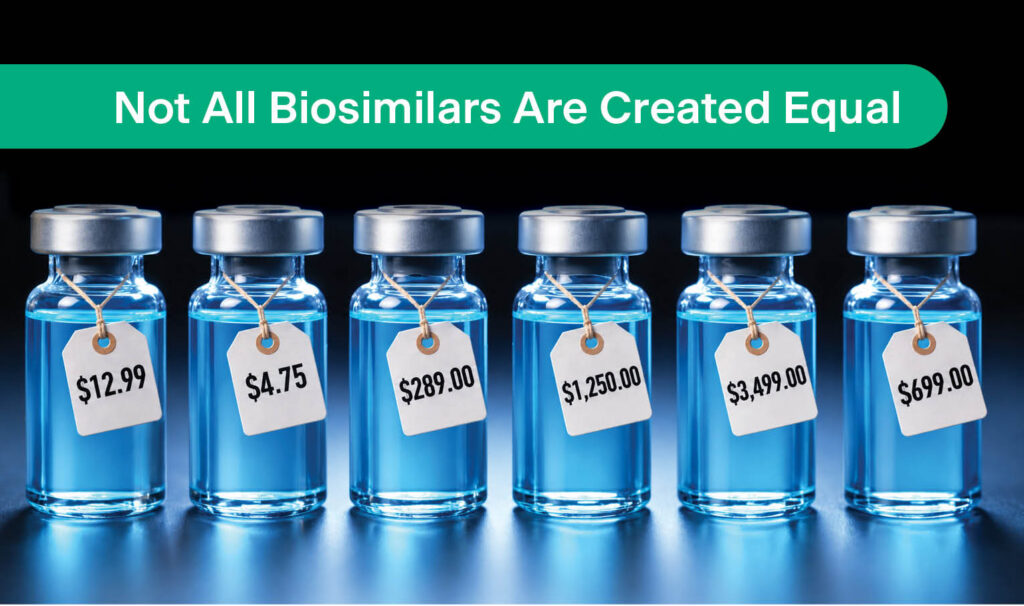
The numbers are compelling. Many biosimilars enter the market at significantly lower prices than their reference products. Humira biosimilars alone have launched with discounts ranging from 5% to as much as 95% off brand pricing¹, creating meaningful savings opportunities for your plan. IQVIA projects that with 118 biologics losing patent protection between 2025 and 2034, biosimilars represent up to a $234 billion savings opportunity over the next decade².
But as the biosimilar market matures, a new reality is emerging: not all biosimilars deliver the same value. Discounts on paper don’t always translate to savings in practice. Some adalimumab biosimilars have actually launched at list prices double the originator’s original launch price³, and rebate structures can quietly erase savings your plan should be capturing⁴.
Increasingly, the question isn’t whether to adopt biosimilars — it’s how to evaluate them, so you can be confident the savings you’re promised are the savings you actually receive.
See how a biosimilar-first strategy protects your net cost →
The First Wave of Savings Was Easy
The initial value proposition for biosimilars was straightforward. A biologic medication priced at tens of thousands of dollars suddenly had a clinically comparable alternative available at a substantially lower cost.
If you were facing rapidly increasing specialty spend, the savings opportunity was obvious. Many plans have successfully transitioned members from reference products to biosimilars, particularly in high-cost categories such as autoimmune conditions, oncology, anti-inflammatory, and dermatology. Those conversions have generated real savings and shown that lower-cost alternatives can be adopted without compromising clinical outcomes.
But that was only the beginning.
The Biosimilar Market Has Become More Complex
Today, many of the industry’s largest specialty drugs have multiple biosimilars available. Take a product like Stelara®: what was once a single high-cost therapy now has at least eight FDA-approved biosimilars competing for market share5. The launch discounts range from roughly 80% to nearly 99% off Stelara’s list price of about $25,500 per dose6. On the surface, that’s a positive development — and in many ways it is. More competition should create lower prices.
Yet when you look closely at the marketplace, the pricing differences between biosimilars can be surprisingly large, even when the products are clinically comparable. One ustekinumab biosimilar launched at a WAC discount of roughly 80%, while another has been priced as low as $360 per dose through a direct-to-consumer channel. The represents a nearly 99% reduction7. You may find yourself comparing products with dramatically different acquisition cost. List price alone rarely tells the full story once rebates and formulary strategy enter the picture8.
That’s where the conversation gets more nuanced. The goal shouldn’t simply be moving from a brand drug to a biosimilar — it should be identifying the lowest-cost, clinically appropriate option available to your plan.
Why Net Cost Matters More Than Discount Percentages
One of the challenges in pharmacy benefit management is that percentages can be misleading. It’s easy to celebrate an 80% reduction compared to a high-cost reference product. But that comparison doesn’t always tell the full story.
If one biosimilar costs significantly less than another, the more important question becomes: are you receiving the best available value? Focusing exclusively on discount percentages can obscure meaningful differences in your actual plan costs.
The most effective specialty strategies evaluate medications based on net cost, clinical appropriateness, and overall value — not simply how much less expensive they are than the original brand.
Following the Money in a Changing Marketplace

At the same time, the biosimilar marketplace is evolving in ways you may not realize. Across the industry, organizations increasingly participate in multiple parts of the pharmaceutical supply chain, including manufacturing, distribution, dispensing, and benefit administration. As these models continue to develop, revenue may be generated in places that aren’t always visible through traditional reporting.
That doesn’t mean every arrangement is inappropriate. But it does reinforce why transparency matters. You deserve to understand how your PBM selects products, whether alternative options exist, and how financial incentives align with your objectives. The more visibility you have into the decision-making process, the better positioned you are to know whether savings are actually flowing back to your plan.
Questions Every Employer Should Be Asking
As biosimilar adoption accelerates, we encourage you to look beyond the initial savings story. Some questions worth asking:
- Why was this particular biosimilar selected?
- Are lower-cost, clinically equivalent alternatives available?
- How are product selection decisions made?
- What is the actual net cost to your plan?
- Are there financial arrangements elsewhere in the supply chain that influence product selection?
- How often are biosimilar opportunities evaluated and updated?
The answers can reveal substantial differences in value, even among products that appear nearly identical from a clinical perspective.
The Next Phase of Biosimilar Savings
The first phase of biosimilar adoption focused on replacing expensive reference products. The next phase is about optimization.
As more biosimilars enter the market and competition increases, you have the opportunity to move beyond broad adoption strategies and toward a more sophisticated evaluation of pricing, transparency, and value.
This philosophy helped shape our Biosimilar Advantage Formulary, which prioritizes lower-cost biosimilars. But the lesson extends well beyond any single formulary strategy.
The future of specialty drug management belongs to the plan sponsors who ask deeper questions, demand greater transparency, and focus relentlessly on net cost — because in today’s biosimilar marketplace, the biggest savings opportunities may no longer come from switching away from the brand. They may come from choosing the right biosimilar in the first place.
We’re here to help you ask the right questions. For You, Yes.
Footnotes / Sources
- Cencora, Humira Biosimilar Landscape Overview; MedImpact, Humira Biosimilar 95% Below Cost, Feb. 2026
- IQVIA Institute, Assessing the Biosimilar Void in the U.S., Feb. 2025
- JAMA Network Open, as reported in Center for Biosimilars, July 2023
- Biosimilars Council analysis, as reported in AJMC: Blue Shield of California Lowers Humira Biosimilar Costs
- Managed Healthcare Executive: Stelara Biosimilar Steqeyma Launches at 85% Discount; Drug Channels: The Stelara Biosimilar Price War
- Managed Healthcare Executive: Two More Stelara Biosimilars Launch
- BR&R: Mark Cuban’s 99% Discount on Ustekinumab Biosimilar; BR&R: A New Wave of Ustekinumab Biosimilar Launches
- Drug Channels: The Stelara Biosimilar Price War — notes that WAC list price excludes rebates and other channel discounts, so list-price comparisons alone can be misleading
Related reading: What Biosimilars Are and Why They Matter | Your Clients May Be Paying for Savings They Never Receive | Why Lowest Net Cost Wins: The Power of a Biosimilar-First Strategy
Give your clients the insights they want.
Fill out the form below, and discover the Serve You Rx difference.
About Serve You Rx®
Serve You Rx is a full-service pharmacy benefit manager (PBM) with unquestionable flexibility and an unwavering commitment to doing what’s best for its clients. With a fervent focus on those it serves, including insurance brokers, consultants, third-party administrators, and their clients, Serve You Rx delivers exceptional service and tailored, cost-effective benefit solutions. Independent and privately held for nearly 40 years, Serve You Rx can implement new groups in 30 days or less and say “yes” to a wide variety of viable solutions. Known for its adaptability, quality, and client-centricity, Serve You Rx aims to be a benchmark for better client service.